Sunday, April 13, 2008

Mail-Interviews - PART 5


The last part in the Book-series of the Mail-Interview Project has now been published. It contains only a few more interviews, but they are also quite interesting. Also the complete lists and details about the project are added with reprints of the hardcopy covers that were made over the years.

Printed:

161 pages, 6" x 9", perfect binding, cream interior paper (60# weight), black and white interior ink, white exterior paper (100# weight), full-colour exterior ink. Paperback book €12.07

Description:

A selection of 5 more Mail-Interviews conducted by Ruud Janssen with International Mail-Artists and Fluxus-Artists in the years 1994 till 2002. This time also unfinished interviews and an overview of all names of the interviewed persons! Includes interviews with John M. Bennett, The Unexpected, Jürgen O. Olbrich, Ko de Jonge, Michael B. Corbett and a reprint of the mail-interview Newsletter that explains the Mail-Interview Project. A part of the book is reserved for reprints of the covers made for the booklets in the 90-ies.

Order online at: http://www.lulu.com/content/2359294

For all books go to: http://stores.lulu.com/iuoma

Mail-Interviews - PART 4


Yes, a next book with Mail-Interviews got published. This time a combination of complete mail-interviews and a collection of unfinished interviews. 21 mail-artists in total.

Printed: 343 pages, 6" x 9", perfect binding, cream interior paper (60# weight), black and white interior ink, white exterior paper (100# weight), full-colour exterior ink. Print: €16.96
Download: €2.50

Description:
A selection of 21 more Mail-Interviews conducted by Ruud Janssen with International Mail-Artists and Fluxus-Artists in the years 1994 till 2002. This time also unfinished interviews! Includes interviews with H.R. Fricker, Julia Tant, Raphael Nadolny, John Evans, Bern Porter, Birger Jesch, Patricia Collins, Daniel Plunkett, Patricia tavenner, Judith A. Hoffberg, Peter Küstermann, Robert Rocola, Rod Summers, Marie Stillkind, Roy Arenalla, Rudi Rubberoid, Stephen Perkins, Klaus Groh, Ruggero Maggi, Vittore Baroni, Svjetlana Mimica and a reprint of the mail-interview Newsletter that explains the Mail-Interview Project.

Orderdetails: http://www.lulu.com/content/2354626

All books: http://stores.lulu.com/iuoma

Because I know some people don't want to order online I will see how I can help there. When I order the books myself and send them out, postage is paid twice. Cheapest way is to order straight from LuLu. But when I have stock here in Breda I can determine how heavy a package is and what the extra postage is. Next month I will give the details.

Sunday, April 06, 2008

Mail-Interviews in BOOK-FORM available

On http://stores.lulu.com/iuoma you can have an overview of the publications that I have made available for you. This includes now two books with the complete texts of 28 interviews I did in the years 1994 till 2007. A selection of the most interesting interviews, including people who are no longer with us like Edgardo-Anonio-Vigo, Ray Johnson, Dick Higgins, Norman Solomon, but also some very active Fluxus- and Mail-Artists. Just have a look.

The information insides these books is always available online as well for free. These books are made for the persons who rather have the texts in printed form so it can be read and archived.

Available are:

Mail-Interviews - Part 2 Mail-Interviews - Part 2 (book)
Print: €16.23
Download: €2.50
A selection of 12 Mail-Interviews conducted by Ruud Janssen with International Mail-Artists and Fluxus-Artists in the years 1994 till 2002.

Mail-Interviews - Part 1 Mail-Interviews - Part 1 (book)
Print: €13.59
Download: €2.50
A selection of 16 Mail-Interviews conducted by Ruud Janssen with International Mail-Artists and Fluxus-Artists in the years 1994 till 2007.

25 Years in Mail-Art 25 Years in Mail-Art (book)
Print: €8.83
Download: €2.50
A book with Biographical materials connected to the the 25 years of active work by Ruud Janssen in the Mail-Art Network. Overviews, Interviews, Dates and events.

TAM Rubberstamp Archive TAM Rubberstamp Archive (book)
Download: €3.75
Hardcover Print: €21.48
This catalogue is made to support the exhibition of the TAM Rubberstamp Archive Collection at the L-Gallery in Moscow, Russia. The TAM-Rubberstamp archive started in 1983 and is currated by Ruud Janssen from the Netherlands.

Wednesday, November 21, 2007

Ongoing Interview with Ruud Janssen

After so many Interview with the first concept it is time for a new concept. I prepared a blog for an interview where others will ask the questions and I will try to answer them. I don't know who will ask the questions, but I know i will answer them. The questions will come as the comments to the posting. I will repeat them as the header of the posting and the content of the posting is the answer. This way the structure of the interview will be determined by the readers of the interview so far. We will see if this works or not.

Want to read? Go to: http://rjinterview.blogspot.com/

Wednesday, September 12, 2007

Mail-Interview with Alison Knowles by Ruud Janssen

The Interview with Alison Knowles by Ruud Janssen

(question sent on 5-4-2006 by e-mail)

Ruud Janssen : Welcome to the interview. Before I start with an interview I always like to read through the biography of the person I am interviewing. Looking at such a career in Art I always wonder, do you still remember when you decided you wanted to be an artist?

(answer on 5-4-2006 by e-mail)

Alison Knowles : Yes, I remember well when I decided to be an artist. It was when my grandmother addressed me as one. She looked at my pencil drawing of an osprey's nest built in the cross wires of a telephone pole and hung it over the piano. I was six, maybe seven years old.

(question sent on 6-4-2006 by e-mail)

RJ : You graduated in 1954 from Pratt University. Looking back at this study, what did you learn there, or maybe a better question is: what didn’t you learn there?

(answer on 11-4-2006 by e-mail)

AK : My graduation from Pratt Institute was in 1956. I had transferred from Middlebury College in Vermont. Because my father was an English professor at Pratt I was able to enroll at no expense in the Art Department

In the nightschool for three years I was able to study painting with Adolph Gottlieb a recognized abstract impressionist at the time. He said very little to anyone, but spoke directly in front of the work to each person so it was a personal critical dialogue about art with each one of us. He made me feel I could be a great painter. at the time I intensely admired Helen Frankenthal, and had acquaintance with the work of Pollock.
Franz Kline also taught in the class from time to time. During the day I studied graphic design and commercial layout. My best class in the dayschool was with the painter Richard Lindner. He was a philosopher and dedicated his thoughts to areas outside painting. We had discussions as a group. We also had an hour to draw together. His concentration drawing technique is really a mediation on time . We would draw for five minutes as slowly as possible with pencil on the paper, not taking our eyes off the subject. We began the class each week in this way. I learned very much from him and use this drawing technique with students today. What I learned there was that I am artist. What I should have learned there was that I am not a painter. However, in those days all artists were painterd.

(question sent on 13-4-2006 by e-mail)

RJ : In a text I read: “Alison Knowles is a conceptual artist doing performance art, installations, sound art and bookmaking”. Quite a variety and definitely no mentioning of painting. It seems that after your formal education some informal education took place. Is this somehow connected to the “New York Mycological Society”[1] ?

(answer on 13-4-2006 by e-mail)

AK : Oh yes, the mycological Society was led by John Cage, who along with my father is my teacher. We went on Sunday walks in Upstate New York near where John lived. We went by bus, Dick Higgins my husband and myself to spend time in the woods together, studying mushrooms and having the time while walking to talk to one another. I find walking together to be the best way to exchange ideas. John was always willing to talk to people proposing an idea or observation. We all became acquaintances and then friends. I knew of John through the New School course he gave in the late 50's and was eager to have some of that wisdom and daring rub off on me. As for painting, my attentions dwindled after a show at the Nonegon Gallery on 2nd Ave. in New York. My diverting to the New School class was gentle and then abrupt. I destroyed all my paintings in a bonfire behind my brothers country house. This is slightly distressing to me now, as they would be easily marketable in Italy.

However, this act of destruction on my part led me directly into the Fluxus family of friends and as I say, connections to the New School and George Brecht, Dick Higgins, Al Hansen and Allan Kaprov, among others. On our first Fluxus tour in '62 I began to write performance events. But perhaps that is another question.
Ciao

(question sent on 21-4-2006 by e-mail)

RJ : When did you meet Dick Higgins for the first time?

(answer on 21-4-2006 by e-mail)

AK : I was invited to a party at 84 Christopher Street by a friend Dorothy Podber [2] and our friend Ray Johnson. It was Dick's apartment. I stayed for three days.

(question sent on 24-4-2006 by e-mail)

RJ : You talked in your previous answer about “the Fluxus family of friends”. When was the word “Fluxus” first used in this circle of friends?

(answer on 25-4-2006 by e-mail)

AK : These friends who did concerts together performed under the banner Fluxus. Simultaneously I would say we felt like friends rather than say a group of actors doing a play together. The term family may be my own invention but I like it. No way to put a date on this, but early on.

(question sent on 24-4-2006 by e-mail)

RJ : The term family is also an indication of how these times must have felt. It is interesting that Ray Johnson also belonged to this circle of friends. Some say he also belongs to the group of Fluxus people but I also read somewhere that Ray never considered himself a “Fluxus artist”. How do you see this?

(answer on 27-4-2006 by e-mail)

AK : Ray Johnson was a mail artist, and founded the Correspondence School.
He never travelled with us, or wrote pieces for performance that we could use. I have many memories of his work, always absurd and interactive.

(question sent on 27-4-2006 by e-mail)

RJ : Could you describe one of your favourite performances of the early days. If possible I will publish the original score with this interview. But I am more curious on how you think back of the piece you choose.

(answer on 28-4-2006 by e-mail, booklets on 6-5-2006 by regular mail)

AK : like "shuffle[3]" alot. It presents the group as a group entering andleaving the hall in a snake-like conga line. I would like to send youmy pamphlet of early pieces called By Alison Knowles. It lists theevent scores from this period. Please give me your mailing address.

(On 6-5-2005 I received two booklets by mail. The first booklet: “by Alison Knowles”, 1965, A great Bear Pamphlet - New York. It contains a listing of 17 scores written by her. The second booklet: “MORE by Alison Knowles”, 1979 2nd Edition, Printed Editions New York. “These pieces in MORE are the writings, spoken parts, poems and events from my environments of the 1970’s. Given the opportunity to reprint MORE, I decided to leave out several of the shorter pieces in the first edition to make room for Three New Bean Events, The Shoemaker’s Assistant, and Bean see also Bein. The collage preface that follows was made by Philip Corner.” As a reaction I sent her some samples of previous mail-interviews that I published.)

(question sent on 6-5-2006 by e-mail, booklets on 7-5-2006 by regular mail)

RJ : Thanks for sending me the two booklets. I also looked on the Internet to find details about the performance “Shuffle”. Online one only finds fragments of what it must have been. On you own site (url: http://www.aknowles.com/) also a lot can be found on what you did. A booklet fits more to the times these first scores were performed. I probably will use the booklets as illustrations for the finished interview. As I read in your biography you came in contact with computers in an early stage. I quote:

“In 1967, Knowles produced The House of Dust poem, possibly the first computerized poem, which she produced with composer James Tenney following his informal seminar on computers in the arts held at her home with husband Dick Higgins in 1967”.

What does a computer mean to you nowadays?

(answer on 8-5-2006 by e-mail)
AK : Nowadays I use the computer for daily email contact and to sometimes send a picture for card or publication. I don't use it every day, and I am not a computer adept but it is a great tool we all agree. I do not use it to do artwork however. All my work seems to be tactile, touchable and musical sometimes (the beans falling down inside the paper) or performances where real people look at real people.

(question sent on 10-5-2006 by e-mail)

RJ : When you talk about performances where real people look at real people I am trying to visualize that. The bean performance is probably a superb example of where this happens. It also involves the musical element. I found a photo of one of those performances (I thought it was on the site located at: http://www.4t.fluxus.net/Where the 40 year celebration of Fluxus in France was documented. What I wonder is: Why beans?

(with this e-mail I sent the photo that is also besides this question)

(answer on 11-5-2006 by e-mail)

AK : beans are not usually used to make art or sound works so my position in using them for both is unique. It opens up the world of art to ordinary things such as edibles. I discover rare information about beans in libraries all over the world. The first of my publications was the Bean Rolls published by Fluxus in the early sixties. The next was A Bean Concordance published by Station Hill Press in the 70's. I am always collecting new information and I find everyone has something to say on the subject. Also, I think it is healthy for artists to have outside areas of research besides their own world. I am leaving for Venice now so please hold the questions for a few weeks.

(question sent on 22-5-2006 by e-mail)

RJ : How was Venice?

(answer on 24-5-2006 by e-mail)

AK : Today Venice is rainy. I am here with a performance and exhibition through July 1st.

(question sent on 24-5-2006 by e-mail)

RJ : Could you tell me more about what kind of performance you did and what you exhibited in Venice? It is raining here too......

(since I didn’t get a reply in September, I resent the question again with attached the concept for the Mail-Interview booklet.)

[1]
New York Mycological Society
Mushrooms are the fruiting bodies of fungi, of which the vegetative growth is typically underground or in wood. Fungi serve a major recycling role in nature, breaking down dead trees and other organic material. Fungi also help nourish trees and other plants, thus playing a key role in the health of our forests. And yes, some fungi can also play a destructive role in nature by attacking living things such as trees. Most mushrooms are not poisonous and quite a few are very good edibles. But some are very toxic and a few are deadly! Unfortunately there are no simple foolproof rules to distinguish the edible from the poisonous. One must learn individual mushroom species if one plans on eating mushrooms. The most important point is that no one should ever eat unknown mushrooms! When in doubt, throw it out! Joining a mushroom club is the safe and fun way to learn about mushrooms and fungi. The New York Mycological Society is a non-profit organization of 150 members who share an interest in mycology (the study of mushrooms and fungi) as well as in mycophagy (the eating of mushrooms). The present NYMS was reincarnated some 40 years ago by the composer John Cage and a small group of other mushroom lovers and students. Mycology is mushrooming! (text from the NYMS – Site)


[2] Dorothy Podber ran the Nonegan Gallery in the mid-1960s and she was associated with Black Mountain friends, the Mole People, the art world and the underworld. She is famous for shooting a stack of Marilyn paintings in late 1964, which she can she considered a performance.

[3] #1 Shuffle (1961)The performer or performers shuffle into the performance area and away from it, above, behind, around, or through the audience. They perform as a group or solo: but quietly. Premired August 1963 at National Association of Chemists and Performers in New York at the Advertiser's club.

Beginning in 1962 Alison Knowles wrote an important series of event scores (instructions for events carried out) which anticipate do it. These event scores were published in A Great Bear Pamphlet (1965) which included scores for Shuffle #7, 1967 ("The performer or performers shuffle into the performance area and away from it, above, behind, around, all through the audience. They perform as a group or solo...but quietly") and Proposition, 1962 ("Make a salad").

unfinished...... but published on 11-9-2007 (c) FHC

Monday, June 04, 2007

New Interviews

If you are looking for a specific mail-interview that you can't find, just lt me know and I will upload it here.

Ruud

Tuesday, October 10, 2006

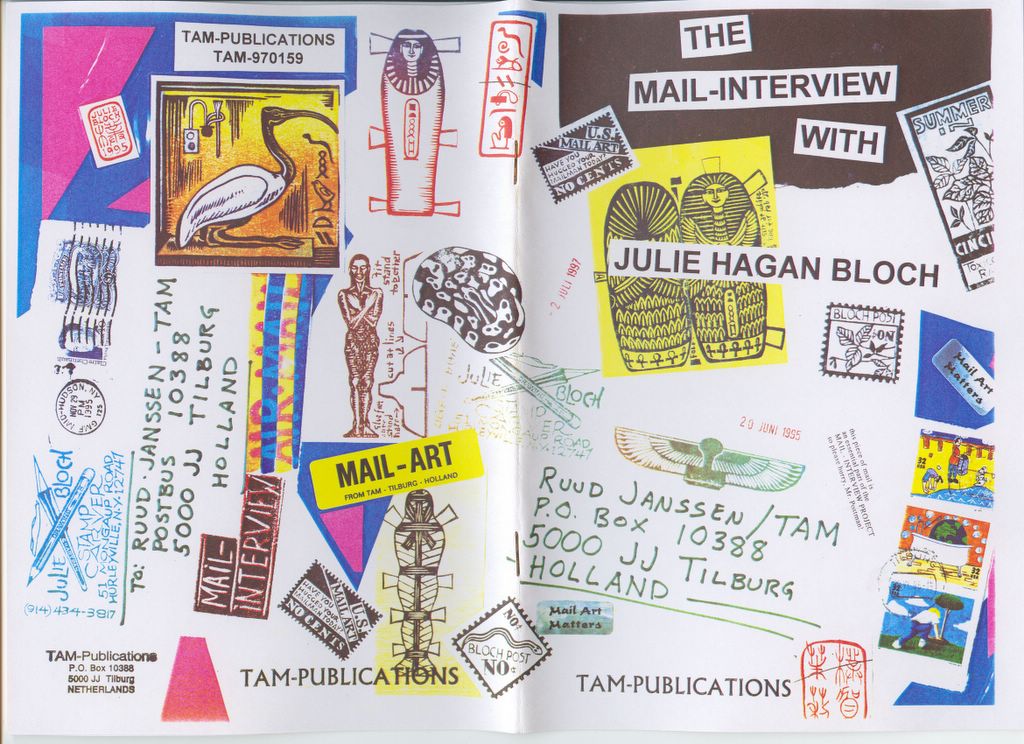
Mail-Interview with Julie Hagan Bloch - USA


hardcover version of the mail-interview booklet

Mail-Interview with Julie Hagan Bloch (USA)

THE MAIL-INTERVIEW WITH JULIE HAGAN BLOCH 31

Started on: 7-3-95

RJ : Welcome to this mail-interview. First let me ask you the traditional question. When did you get involved in the mail-art network?

Reply on: 20-6-1995

JHB: Well, It was probably around the early '80's.... 1983 maybe. It sort of pounced.... I'd been carving eraser-stamps for a few years & heard of a couple of rubberstamp magazines, Rubberstamp-madness & National Stampagraphic. I wrote to them and they both showed favorable interest in my carvings right away. Very quickly I was corresponding with some folks via the rubberstamp magazines, and also got in a group that exchanged mail-art on a monthly basis. I forget the name of the group now; it was in 1984 or 1985 , but I still correspond with Kay Sluterbeck & Tom Nelson whom I met in that group. That group may still be going on as far as I know; after a while I had to drop out because of being short of extra time! I'm still short of "extra" time, but I work around it!

Anyhow, these few contacts led to others & I just kept going with it! Always, though, what intrigued me most was eraser-carving. Still does. Other things get put aside so I can do more carving. One thing that's so great about mail-art is it's an ideal form for sharing carved images. Mail-art lets me feel in touch artistically, even though I live in a very small town. I truly cherish my fellow-artists/correspondents. I have the best of it all here - peace, quiet, & lovely surroundings, and contact with other artists. Our post-office enjoys the unusual variety that gets sent to me too. I give them samples of the artistamps I make, and they put them up behind the counter. Like my own refrigerator-display! (In your country, do the mothers of small children tape up the kids' artworks on the refrigerator door?) Well, enough for that question, nu?

RJ : Well, maybe you should do a project on refrigerator's doors? Mine is decorated with magnet-artworks I received through the mail.... Your eraser-carvings are quite well known in the network. Sometimes your work is even used as illustrations in books. How did you become so good? Maybe you could tell me how the proces of making one stamp evolves.

Reply on 21-9-1995

JHB: The first part is having an idea you want to work with! Then, tools assembled, do your drawing, work with it until you're pleased with it, transfer it to the eraser, and carve it! Often, I continue the drawing process with the carving tools: refining, deleting, adding texture, or re-designing if I either change my mind or make a mistake! And I'll let you in on a little secret: the end result is hardly ever exactly as I had envisioned it! But also, it's hardly ever worth re-doing; time's better spent on trying not to make the same "mistake" on another carving - or else using the information gained deliberately to create a similar effect.

The key to gaining skill in the process is not unique to eraser-carving. Practice. A lot (I've carved over 2,000 stamps by now.) Love the work. Put your heart & mind to it. Concentrate. Have fun with it! Be open to learn whatever you can from a variety of sourses. Recognize that all your skills are a gift, and use them with love & respect. Practice. Love. Attention.
I made a stamp about this topic too: "ALL-PURPOSE MAGIC TRICK LEARNED WHILE CARVING STAMPS: Don't work carelessly, thinking, "why be careful? I can't do it well, anyhow." because then, you'll probably be right. Take the time and care needed, WORK AS THOUGH YOU EXPECT TO BE ABLE TO DO IT VERY WELL because then, you'll probably be right."

(This complete text Julie carved in a eraser sometimes in very tiny and precise letters. The carving shows her very wonderful skills when it comes to making eraser-carvings with very fine details)

Oh - a few, actually: "CHECK OUT the work of wood engravers and wood block carvers!" , "What to carve? Look around you! Look inside you!" , "Contents: Helpful, I hope, but NOT TO BE TAKEN TOO SERIOUSLY.... Do whatever works for you! Invent something new! JUST CARVE!!!"
(These are all on the back cover of my little carving book.)

Another point about skill in carving is keeping the enthusiasm fresh. One way I do that is to apply eraser carving to whatever my current interest happens to be. (For heavens sake, one can carve anything!) Lately I've been fascinated with ancient Egyptian art & hieroglyphs. (Sadly, I'm lacking a teacher for hieroglyphs, but I do have a couple of excellent texts to work with.) I'm having a wonderful time with it all, and of course it shows up in carved stamps!

RJ : Yes, it sure does! Do you also carve in wood and make larger works?

Reply on 12-10-1995

JHB: I have carved in wood in the past, but haven't for years. The grain of the wood always seemed to have a different opinion than I did about where a line should go, & we never reached a mutual understanding.

I also used to do larger works - when I was in art school ( a little over 20 years ago!) I preferred large canvases, say 4 x 6 feet, & 18 x 24 inch watercolors & drawings.... But as the time goes by I find that I prefer to work much smaller for many reasons: large pieces require physical strength to manipulate & lots of space for storage, & are harder to share with people many miles away. And large sized works are easy to accept as they are, in the sense of size, and the viewer remaining as is..... Small works seem to ask the viewer to become of a size to enter the work, because it's too hard to see it well otherwise. One must change & enter into a different view of the world. I guess that sounds weird. That's okay. Wierd is fine too. It's good to help shake off the idea that some people may have that this existence is "normal", whatever THAT is. Magic is normal, & it's everywhere! Just walking outside today, in this gorgeous Autumn weather one breathes magic! It's more than just the delightful beauty of scent & color.... it's a feeling.... I love it!

It's necessary for me to try to convey some of this in the thing I do. Wether it comes across or not, well, who knows? But it is important that I try, & the magic is ALL of it - the form, color, feeling, & my state of being as I work. I think people would do well to remember we can all do magic. Putting one's heart and spirit into a made object - that's magic and very healing for the doer & the viewer. I think one also receives the blessings of whatever the attention focuses on, and of course blessings are extended to the object or place or person or animal that is drawn or carved.

RJ : In the latest pieces of mail I received from you, I noticed that you are influenced by old historic subjects these last months. What is so attractive about the Eastern culture?

Reply on 2-12-1995

JHB: Ruud, I could say any number of things about this, but the main thing is that it just touches my heart. It is beautiful in a way that for me is magic, and it makes me want to be closer to it.

I was at the Metropolitan Museum of Art (in New York City) several months ago, standing before some acient Egyptian tomb carvings: scenes & hieroglyphs... tears came to my eyes and I wanted to know the heart of them, to be closer to that beauty. So since then I've been studying hieroglyphs when I can, & looking at the drawings, paintings and sculpture, in books or in museums. It's magical, mysterious, seductive, lovely. It's for the same reason I studied Chinese 15 years ago: the art captures my heart.

RJ : Is it the story of your life, that you always follow what your heart tells you to do?

Reply on 3-2-1996

JHB: What a beautiful question! I think that's probably true for the major events of my life, and I believe that a lot of the time heart & head are in agreement.... or at least they conspire to make it seem so.... Even contemplating the question brings a smile to the heart & a feeling of love. What treasures these feelings are! To be in a space of love & beauty, just by thinking about them. Now there's magic! Thank you for bringing it on!
ps. Sometimes the pull of love is so strong, it's not a matter of choice: the only possible thing to do is to follow one's heart. Nothing else exists.

RJ : Again you sent me some beautiful prints of your newest rubber stamps. Do you keep all your erasers? How large is your collection?

Reply on 21-2-1996

JHB: No, I don't keep all my carvings. Some I make as gifts, some end up as gifts, a very few are commissioned pieces. But I do keep most of the carvings I make. I probably have about 2,000 and I like always to have at least arround 50 uncarved erasers on hand, plus some of the larger sizes of carving material like Nasco's carving block, April Pease's "P-Z cut", & a few others which I can't recall just now. Sometimes I get an idea to do a series of carvings that eats up my supply of erasers, so I need to be prepared! It's best to go with the idea when it takes you by the hand. I love it when I'm able to just flow with the idea & draw and carve for long, uninterrupted stretches.

RJ : You sure are lucky that you can do that, and the results are really wonderful. When I myself got involved with the mail art network the magazine Rubberstampmadness was quite interesting for mail artists (as you told also in one of your previous answers). The most recent issues I saw of the magazine were completely different to the ones from the beginning of the 80's. It has become a very large glossy magazine with lots of advertisings. What are your thoughts on these developments, that rubberstamping has become big business?

Reply on 5-3-1996

JHB: There is room for everybody & for all of it. RSM has evolved from charming, down-home small publication to classy, professional larger publication. It reaches more people now, yet has information on networking for many levels, some really cool artists, & so forth. Folks who wish to be less "glossy" are not prohibited from being so, for heaven's sake! I think it's a waste of good energy to get upset with people or entities for changing, as long as others are still free to go their own way. National Stampagraphic is a lot like it used to be years ago, very low-key, & lovable. That's the key, I think, to why these 2 (RSM & NS) are still around - love. It's not how "glossy" you are or aren't; it's how much love you work with - (and, of course, simply staying in business is due in part to luck!) - and both are full of love. There's so much "us" versus "them" in this world - it's time people realized that there is no "THEM" ; it's ALL JUST "US".

And what's wrong with glossy, anyhow? I can't find fault with better reproduction of original pieces, more information on cool toys (via - 'gasp!' advertising!) - show me where this causes harm? If there's to be a complaint, let it be with real problems - like polluting our lovely Earth, torturing animals or people, stupid wars, supressing of others' beliefs, other forms of bigotry (religious, racial, social, etc.) OY VAY! You want problems? EASY to find. You know what else? I'm a lot different than I was in the beginning of the 80's too! And it's great! (and so are you, dear; you got me going on that one, didn't you!)

P.S. I bet there are lots of other rubberstamp publications out there that are very low key - this world is full of surprises!

P.P.S. I could get more in-depth philosophically, but it makes my ears itch. Enough philosophy already, let's make art!

RJ : Yes, I got you going there for a while. Sometimes it seems that art & money don't mix, but in reality they seem to be completly connected. In the 70's and 80's there were these discussions that mail art and money don't mix. Nowadays, with the high postal rates everywhere, the mail artists of the 90's know too well that money is needed to keep the post going and lots of recent larger mail art shows are sponsored to pay for the costs. What are your thoughts on this subject?

Reply on 2-4-1996

JHB: It seems to me a bit like complaining about the weather. Like it or not, what can one do about it? Individual solutions: make more intense (whatever THAT means!) art & correspond with fewer people, making a stronger individual connection; do mass-mailings but less frequently; get a grant; work with people in a smaller area & personal contact (within art schools, for example); pray for postal rates to go down! In fact, Ruud, I saved (somewhere - can't find it at the moment) a little quote you mailed me a year or two ago, something to the effect that one might reconsider methods if one is continually sending a mass-produced letter about "Sorry I'm sending a mass-produced letter, but I don't have time to write". Why not pare down the number to those with whom quality correspondence is enjoyed? Mail art is supposed to be for enjoyment (isn't it??). Or, admittedly, at times to make a social or political point - but I suspect most of us do mail art because we like to. And in honesty I must admit that I seldom respond to "calls for mail art" for any given event unless the call is accompanied by a personal letter of some kind. Of works to do, I have plenty already, thank you! As I said: for me, it's about love, not how many pieces of mail I can move in a day.

As far as art & money mixing - well, sometimes they do & sometimes they don't! Clearly, one needs to survive; and clearly, art needs energy, love. time, & other resources. It can be more subtle, too. In 1991 I got breast cancer. I know why I got it; I was depressed because, due to having to take a "real" job, I couldn't make art.

(...wow - I had to stop a moment & the moment stretched to over 2 weeks! Time-ways!)

...so - with that diagnosis came the renewed determination to do what I believe I came here to do: show love for this amazing All-of-creation with my art. Please understand, this doesn't imply I'm any kind of world-class master artist. It just means that, for my own personal life, I must work with beauty, with love. Like birds who must sing, no matter what their song: crow or lark (I like them all!); no matter if they're heard or not.... though, to be sensible, I suppose the song often serves to attract mates or announce territorial borders... but I bet they'd sing anyhow. Lovely things, birds. Like listening to Kiri te Kanawa, for example, or Kathleen Battle.... like angels singing. Healing to the spirit.

Back to the question - yes, it is a shame when folks can't afford to mail as they'd like. When I was first married, money was very tight - though we had enough to physically survive, thank god - & I do remember not mailing as often as I would have liked, in order to save money... but what I did then is to do what I could do, & not get my shorts in a bunch, so to speak, because of what I couldn't do. I don't have enough time to waste it on being critical like that. As I said before, do what you can do, and with love.

RJ : The envelope you sent your answer in was made from a page about astrology. What does astrology mean to you?

(On April 25th I received a first e-mail message from Julie Hagan Bloch. Nothing special, but just a test if she could reach me that way. I replied that here first e-mail arrived and that she could send in her answers that way too. However, I also told her that I would enjoy her snail-mail more because of the wonderful stampings she always uses).

Reply on 4-6-1996 (internet)

Hi, Ruud!

Yes, I will be sending you some goodies in the mail but I'm feeling a tad guilty at how long it's taken me to respond to the last question so I'm answering with the help of Thoth Ram‑Dos (I did tell you that's our computer's name, didn't I?).

Astrology. I guess for me it's another bit of potentially useful information. Seems to me that this whole universe is pretty much all of a piece, as it were, and that everything is therefore interconnected. I'm not an astrologer. Not enough time to devote to it. But now and then something I'll read in an astrology journal or and ephemeris will ring a bell and help me to gain a little insight. For example, the time I got breast cancer was when transiting Pluto was squaring my ascendant. (Yes, I know it sounds like gobbledygook. Well, it can't be helped.) Pluto has to do with deep transformation, sometimes pretty heavy duty. The ascendant is one's self‑in‑this‑body, for lack of a more succinct explanation. So. Does that help?

On a different subject, David does the grocery shopping for our household, bless his heart. Last time he went, he brought back a golden‑orange pepper, "just because it was so pretty". Now, I ask you, is that man a treasure or what? I'll be sending you a few little eraser‑carvings I did using that pepper as a model. It really is a lovely thing, that pepper. The color is exquisite, and the shape of it is wonderful. The funny thing about it is that, since the U.S. Post Office recently issued a commemorative stamp of one of Georgia O'Keeffe's paintings (the red poppy), I was looking through a book I've had (for almost 20 years!) of her work. I had in mind to think a bit about her and what she did, and perhaps carve a print or two in her honor. Looking through that lovely book, I was struck most by her just working with what delighted her eye. And that evening, David brings home the pepper. Aha! So in a way, the pepper prints are in honor of Georgia. What an incredible woman she was.

I'm also thinking that perhaps I'll go to the grocery store myself (I hate to shop, but maybe it wouldn't be so bad if it's for art supplies, so to speak), and see the shapes and colors in the produce department. In the seed catalogues I see lovely fruits and flowers and vegetables...peppers, for example, in red, green, yellow, orange, white, purple, just to name a few!

I'll send the prints off to you in the morning. Meanwhile, happy Spring!

RJ : Now I think of the subjects of your eraser carvings, it has mostly to do with daily life as well. You latest answer came in by e-mail (you actually wrote it a few hours before I got it today!) and I wonder, what is a computer too you, and what do you think of e-mail?

(this next question was sent only 30 minutes after I received her answer, by e-mail of course!)

reply on 2-7-1996 (internet)

JHB: HA! I just remembered where I put the interview question. Oy... when I get behind with paperwork, things do get lost! Okay, the question was about Thoth Ram‑Dos, our computer, or computers in general.

Computers are great. E‑mail is a big help for quick communication (well, it CAN be...!) and can be fun besides. What's not to like? The regular postal system still can be used for sending pictures and what‑not. It's good to have both. The more options, the better. It's not as though use of the more traditional mail systems is now prohibited, for heaven's sake!

Besides the e‑mail, I hope eventually to be able to use the computer for producing our books, which is the reason we got it in the first place. We still need to get a scanner, though, and until we do we can't do the books from the computer. There's a program that can use my own calligraphy and use it as a font. (First have to have the scanner!) I like doing a LITTLE calligraphy, but it's getting so that my hand and shoulder cramp up too quickly to really enjoy doing an extended session of it. I do want to use my own lettering in our books, though, and having it available as a font is the way to go. Besides, that way I can spend more time drawing and carving, which I prefer. There I think the computer will be a help, too. In fact, that's the argument my husband used to get me to consider a computer in the first place. He said: "Think of being able to have your original artwork, blow it up big on the computer, touch it up, reduce it back to the original size, and have it camera‑ready." I told him, "Oh, you tempter!"

And so Thoth Ram‑Dos came to live in our house. I love the drawing and carving but I do not like to do the fiddly work involved in getting an image camera‑ready. Once an image is carved, I want to do something else! There are so many things that I'd like to carve!

RJ : Besides the e-mail there are also the sites and homepages where people put their information on-line. What do you think of that?

Reply on 11-7-1996 (via e-mail)

JHB: I don't yet have a lot of experience with this part of the internet. I've played a bit with it, of course, but it still feels like getting a new foreign language textbook and skipping to the middle or end chapters: sometimes one is able to make sense of bits of it, and it is fun to work with it, but to really GET it a bit more study is required.

My impression as a novice is that one could easily spend a great deal of time in it.... So far, I've not had a lot of luck using it as a research tool. Although it seems almost everything is represented in some capacity, the representation usually is rather superficial. At present, I have far better luck in a good big bookstore. It isn't as time‑consuming to "download" pictures in a bookstore, either! Using Georgia O'Keeffe as a reference again, I found a scant few illustrations of her work on the internet, but in a bookstore, aaah! Lovely illustrated volumes, and the main problem is to choose which to buy! Such riches...

At any rate, I'm sure there is much good material in magic cyberspace, for one who knows how to access it. I'm sure I will eventually. I did have some luck, surprisingly enough, in finding eraser‑carving‑related items on the internet! The luck consisted mainly in having friends tell me the home page addresses (if that is the correct term) for them. I found yours, Ruud, and a few others. What fun! Yes, I can see how one could spend a LOT of time there!

Incidentally, Ruud, my lack of expertise is the reason for the delay in responding to your question. I don't have a lot to say that means much. But heavens, for not having much to say, I sure did natter on, no?!

This kind of communication is a far cry from that of even 50 years ago. I wonder what will be available in another 50 years! I guess that's all for now. Be well, dear. Love and blessings, Julie

RJ : Another subject I would like to ask before we end our interview is, "your archive". Do you keep all the mail that you get in? How do you deal with the flow of incoming mail?

reply on 5-10-1996 (e-mail)

JHB: Your last question related to archiving: "Do you keep all the mail that you get in? How do you deal with the flow of incoming mail?" As you can tell, sometimes the flow of incoming mail does not have a corresponding outflow very soon! Some mail is answered quickly, such as orders for the small books I publish; I try to fill orders and mail them out again within 48 hours. Questions about carving I put at the front of my "mail to be answered" stack. I must confess that though I like to answer mail promptly, often that stack waits a while for me to attend to it. The nearly three‑month interval between your last question and my answering of it is surely a case in point! It was an interval, however, that saw the completion of the camera‑ready copy for the next haiku book, which is now at the printer's awaiting its turn on the press. (I am glad about the book's reaching that stage, for sure!) Usually when I begin a correspondence with somebody, I warn her/him that while I do answer my mail, the timing of the answer is totally unpredictable.

I don't keep all the mail that comes to the house. There's just too much of it. I keep what is special to me personally for one reason or another; and most of the rest of it I pass along. Some things that are not "keepers" but are of a large enough size, I use to line the bottom of the rabbits' cages when I clean them. I have to use something, after all! Mail art is sacred in the sense of the communication that takes place, but not necessarily as an object once its purpose has been fulfilled. Besides, paper does not keep forever, and space is somewhat limited. The more one has, the more time is necessary to take care of it. I have fantasized about dumping the entire contents of my files into a bonfire, and enjoying the lightening of spirit that accompanies lightening of posessions... but then when I go to weed out some of the files, I end up keeping most of them after all. "I can't throw THIS away...". The trick in not becoming inundated in paper is to be strong in the first place and not let the paper enter the file at all; pass it along right away. It isn't easy. When a piece has been put together with a lot of care and love, it is hard to let it go. But then, it is also fun to share nice work with mail art friends. It is a bit of a paradox for me. I like to have interesting things on hand to look at and respond to, but I don't like to be responsible for a lot of stuff to take care of. And I like things to be fairly tidy and clean, and of course the more things there are in a space, the more complicated that becomes. I find it easier to think clearly in a clean space. Not only a physically clean space, but also a mentally clean one. If I have too many things to do, I often find it hard to accomplish anything beyond the most essential tasks. The mental system (or mine does, anyhow) gets overloaded with too many things to do, it seems, and fizzes out. Poof! It's a great exercise in focus, though, to concentrate on one bird in the flock, as it were. It is an interesting question: if a system is best served by simplicity, then why is there the tendency towards complexity?

Ummmm, I dunno. I'm a slow learner, maybe??? ;‑) Back to you, Ruud, and I hope you are having a fine Autumn. It is so very lovely here now. I love this time of year. The trees are so spectacular in their blazing brightness, and the clean, crisp air is ambrosial. Aaaaahhh!


P.S The lift of spirit that follows the letting go of possessions is mild compared to the lift felt after completing a major task. It's almost as though a physical weight were removed from me. ( I wonder if it's like that at the time of death, the feeling of a major job completed, great relief and lightness, and now it's time to move on to the next thing...) I love the work I do, but completion is nice too.

There, that was my after‑midnight nattering!

RJ : Well, maybe it is time to round up this interview. It started in March last year, so if we don't stop now we might 'natter' on year after year (just joking). Was there anything I forgot to ask you?

reply on 26-11-1996 (e-mail)

JHB: I don't know if you forgot to ask anything or not, but there is one more thing I'd like to put out there for people: There is a great light at the very core of your being that is made of nothing but love. Find it. And realize that the light wears your form, has your tendencies, your loves, your brain, your skills, everything that makes you who you are. You ARE good enough. You are great, just as you are. You must do what makes your heart happy, what you know is right for you in your own circumstances. Honor who you are. Everyone has this light; it is everywhere and in everything. We are surrounded by love.

One of the finest things about mail art is that people share their own unique vision, freely and without external judging. They share who they are. We are surrounded by love.

Well, Ruud, no doubt there will be something else I'll remember after this is all done, but I can live with that! I suspect that the "nattering" will continue in any case! In the snail mail printout of this that I'm sending, I'll enclose the latest haiku book, hot off the press, as it were. I hope you like it! Now it's back to answering other mail, trying to fit in as many projects as possible (one of the first of which is revising my carving book. It's hard to believe it's been out for almost ten years...products have changed, and there is more I want to share with those who'd like to carve! The more I teach, the more I notice patterns of things people keep asking, or not realizing that they need to know. I need to address that in the book) , and not wear myself out...well, not too much, anyhow. Bless you for doing this project. It's led me into some helpful contemplations, and I hope that it may be of some interest to the readers. Be well, be happy, and remember that you are fine, just as you are, and made of love.

Love and blessings,

Julie

RJ : Thanks for this interview Julie!


Address mail-artist:

Julie Hagan Bloch,
51 Mongaup Road,
Hurleyville
NY 12747-5406
USA

e-mail : blochprint@zelacom.com

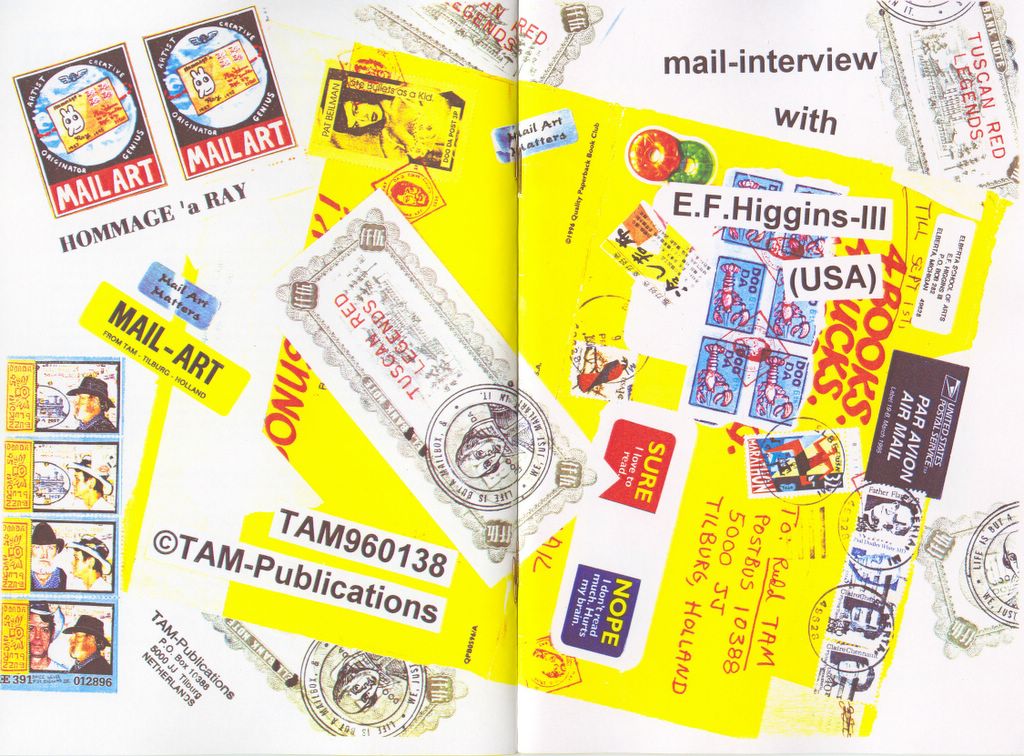
Mail-Interview with E.F. Higgins - III - USA


cover of the hard-copy version of the mail-interview

Mail-Interview with E.F. Higgins - III - USA

THE MAIL-INTERVIEW WITH E.F HIGGINS - III

Started on: 16-05-1995

RJ :Welcome to this mail-interview. First let me ask you the traditional question. When did you get involved in the mail-art network?

Reply on: 15-9-95

EFH:Thanks for the invite to the interview. I haven't been doing much international mail art for a number of years, due to the postal rates, & I was spending US$ 700 a year on postage there for a while. To answer your question, I got involved in the mail art network about 1975-'76. At the Univesity of Colorado, I was working with paintings & printmaking, working from "2-D" objects as my models. Posters, Postcards, Play money, Stamps, envelopes, etc. I produced the first sheet of Doo Da art stamps in 1975. Right around that time a visiting artist. Edwin Golik Golikoff, a N.Y. Artist, living in Denver, told me about mail art, Buster Cleveland, Ray Johnson, Anna Banana, etc. I started mailing the stamps, collages etc. around then.

RJ :What were the first reactions of the people you started to mail your works to?

Reply on 5-10-1995

EFH:That would be hard to figure, as I wasn't there, when they got their mail. Mail art is neither a wrapped gift to a friend at their birthday Party, nor a Rauschenburg, in a show, in a Museum, in a collection, reproduced in an Art Business Magazine, commented about by "Art Critics" etc. etc.

Judging from the responses, from other artists, through the mails, some of my stuff must have interested some to respond. The many different mail artists' correspondances revealed the miraid various influences affecting these artists. Golikoff used a typewriter, & puns in many of his letters & postcards. Ray Johnson, his grey copies of drawings, gosip, & puns. His
surreal puns, sometimes understood. Concrete poetry, newspaper & picture collage, pornography, manifestos, self-documentation, self- historification, self-promotion, were some of the things sent, received, & seen in mail art show catalogues.

One of these things were stamps; on the letters from real countries, artists stamps, & rubber stamps. Due to my background interest, I gravitated to corresponding, with these concerns, to other artists & shows having this as a format or main idea. The 1975 Show of Artist Stamps at Simon Frazier university, B.C., Canada, organized by Jas. W. Fetler, visually introduced
me to the world of the following artists from that show: Pat Tavenner, Joel Smith, Donald Evans, Ken Friedman, Robert Watts, Bernd Lobach, Endre Tot, Klaus Burkhardt, Carl Camu, Dieter Roth, George Ashley, & Ad Varney of the Coach House Press.

I was a painter & printmaker, and carried these diciplines into my mail art activity, most notably, Painting Doo Da Stamps. Often these 16" x 18" paintings were photographically reduced, and printed as sheets of stamps with the color copier, perforated, & used in mail art. As a printmaker in the traditional methods, the color copier was an explosive discovery to me.
No longer did time & money restricted the imagery, edition, distribution etc. To spend 2 hours each pulling an edition of Etchings, tends to discourage mailing off a dozen or so to friends, and push one more into the $ Art Gallery system.

RJ :I can understand the influence of a color copier. Some choose for a large color copy, but it seems you like to reduce your works to even smaller pieces, into artistamps. Why is this artistamp so interesting for you?

Reply on 17-10-1995

EFH:To color copy print from a large un-related artwork, such as a painting, sculpture, etc. , as an edition print seems silly exept as documentation, doing huge injustice to both the original medium & the traditional printing process. Picasso may have done a series of etchings
based on his painting "Guernica", but the prints intrinsic method, process,
look, have more to do with these concerns, than reproducing the painting. He didn't print 300 color copy prints of a photo of the painting.

When Warhol painted a 12 ft. square "Hammer & Sycle", "Deaths Head", or whatever, he probably had a pretty good idea it would "Read" when reproduced, 4 inches by four inches in some art magazine. Hireonimus Bosch probably didn't have this thought occur to him... check it out. Photography has changed the making of art, & definately Art & Business. Wouldn't a 12" x 12" Warhol have sufficed?

When I paint the Doo Da Stamp Paintings, it is understood by me that they are ment to be used to make stamps. The lettering is there, the 3P or what- ever denomination is there. It isn't, in most cases, added later. Hence, the painting becomes, what traditionally was known as a rough sketch, ie, a creative work done in the process to achieve the invisioned final "Work". To delegate painting to this role, "making color copy artstamps", turns tradition on its head, & really pisses off the Art Gallery system.

If creativity, through a process, isn't TRANSFORMED BY THAT PROCESS, it is hardly creative in my opinion. A photo, slide, or color copy may be functional, helpful, or useful in describing another artwork, but unless it is transformed, it's work$job.

ARTISTAMPS, like their traditional cousins, "Govn't minted miniature prints", share significant similarities - the main one being, I think, the imagry on them, ie "relating to the people, lands, ideas, nature, accomplishments, celebrations, religions, etc. of the country." The
correspondence carried by the regular stamps, becomes the correspondance, carried by the Artistamps in mail art, that joious dance of the muses amongst us.

How wonderful to have perhaps correspondanced with a guy from the "country" of Gauguin, Cavellini apparently correspondanced with some amazing "countries" to hear him tell it!!!

What kind of artstamps would a "country" of Picasso have produced?, & my!, wouldn't that have been fun.!!!?

The "COUNTRIES" of TUI-TUI, Blurr, BANANA, TRIANGLE, JOKI, & NETLAND, to name a few, are alive & well!!! By in large, unlike the Govn't issues, these countries have the continuity of one or two creative beings in charge of the postal issues for many, many years.

If you ever got a letter from someone in a different country, the stamps, & rubber stamp cancellation marks were a wonderful part of getting that letter. Sometimes their correspondence to you reflected the stamp imagery or not. Artistamps on mail art is a BEAUTY!

I have seen wonderful stamps from countries I may never visit - some even
with that country's art I may never see. With artistamps, the ART VISITS
YOU, not you visiting the museum! I am not against travel or museums,
actually, I love both, but to have these "COUNTRIES" visit YOU,
sometimes unexpectedly, is a treat!!!

P.S. During construction work, that I do to make a living, when somebody screws-up, I put two things to them: #1 "There's 4 things you gotta remember if you want to be a plumber:

(1) "H" stands for hot.
(2) "C" stands for cold.
(3) Friday's payday,
(4) & SHIT DON'T RUN UP-HILL.

The other thing I put to them is more insideous. After they've escaped a major disaster, for themselves, as well as others on the job, I ask 'em, "HEY! WHO PAYS YOU????? & before they can answer, I yell in their face, "SAFETY PAYS!!!

Not too long ago, here in America, some young kid burned down the house, a trailer actually, having learned fire is lighters & fun from some cartoon character named Bevis & Butthead. And now, to legally sell lighters here in Amreica, they have to be "Child-Proof". The only swear
word or obscenity I ever heard my father utter, in 50 years, was ___________, as he was teaching me power tools when I was, .... oh, maybe 13 or 14 years old, when he nearly cut off his finger.

RJ :Are there other stories of your childhood that have had an impact on your the art you produce nowadays?

Reply on 14-11-1995

EFH:Stories? ...?

RJ :Ah...

EFH:Well, there once was a gal from Nantucket...

RJ :Actually, influences.... were there any other significant ...

EFH:Oh, ... you mean like stuff places, & people?

RJ :Yea.

EFH:I suppose, in everyones' life, there's things to remember; if you asked anyone else, they'd say something like, "What?", even if they knew them very well, when they heard the reply. When I meet people in bars, I tell 'em: "I'm 59 years old." I think I've been doing this for the last 10 years or so.

As a youngster, growing up in a small town outside of Chicago, I had the good luck, or some may say, the "IMPRINTING" (like you see the T.V. show showing you how to have the young condors learn the wild, by eating raw meat from a puppet hand, that looks like a (they suppose) adult), to learn many things.

Probably, if anybody's still around, from back then, they'd tell you a
different story, than what'd you figure from .. say the writings of Jules
Verne, Lewis Carrol or Edgar Allen Poe. "So the guy sez to me in a bar in Kankakee, Ill. , he was out of work or something...., 'apparently this guy breaks into the PICASSO museum ... didn't like a painting, or sumptin',,,,& PAINTS OVER A PART OF IT!!!!!!!..' "so the story goes,";&
Picasso himself was in town, or sumptin'....& they get him out there for insurance purposes, you know, to assertain the damage, & whadda think he sez... you know, after looking at it and all...??? 'I look into the distance, trying to figure what the pablo might have'a said, as I looked him up & down, figuring iz this guy crazy or can he buy me another beer, when he says something....'

You mean that kind of story?

RJ :What's Picasso say?

EFH:Well, He looked at the "Damage, & pulling at his jaw, said "Not Bad."

RJ :"Did he actually..."

EFH:"Oh, Not that story...... O.K. , Hello Buster, to assume a painter, Stamp maker, or what-ever didn't used to have some fun at writing would be to deny Claes Oldenbug & all of Chicago humor.

Here's the thing: Since RJ asked the question about other stories of my childhood, "that have had an impact... etc....", I have invented his "dialogue" or return questions. I don't have a computer or e-mail....& have been corresponding with a young cartoonist that..... He does the drawing. I'll do the story line. Met 'em on the train from Chicago to GRAND CENTRAL.

So, If RJ decides to run this part of the interview, please understand, we didn't just send mail to undrstand one short word... Sometimes people talk like that. Ruud, my apologies.

Trying not to get side-tracked, on the interview, but it depends on how you're traveling, & but, anyway, we all gotta stop for eats, piss & Clear Stars.

THE ASS HOLE MUST THINK HE'S A WRITER Chapter 2 , Hemmings' typist gor $25. Bucks a page (back then)

Well, enough of my....a....ah....., well, anyway, if this is supposed to be about Artistamps , or mail art, ....here's a reply from Joel Smith, from Illinois, Illinoise. (One of the best, in my opinion, that makes Art Stamps).

(E.F. Higgins included a copy with a small text about Joel Smith's Artistamps where is explained shortly how he makes them and motivated why....)

RJ :What do you think is important enough that I should ask you? Don't start to think too much, just figure out what you think I should know, and than give the answer.......

(After some silence I first received a postcard from E.F. Higgins, and a bit later his answer with in the envelope also some of his new artistamps).

Reply on 4-3-1996

EFH:Art. At some point, in the development of human beings, we noticed our ability to control our bodies. At first this was mostly useful, to survive. & reproduce. At this early stage, was the start of many future developments, that chrystalized for thousands of years, to get to the point
of drawing bison on cave walls.

The brain was developing also. Cause & Effect. We get together to chip the flint this way, (the 'ol guy said so), tie the gut rope, such way on the wood (tree-part), & we stick into the big eatable-thing.

28 years old, was OLD. GrandPaw,.....maybe.

And so they persevered. These Humanoids. With their brain growing, their skills developing, & & The strongest leader, always led. But, DRAWING the sticking on the wall!!!! WOW What is that?

Apparently, or maybe, the early OLD, (previously BIG STRONG) learned
how to run a crew & explain, in whatever "language" they had back then,
how to get the food, & not get dead, on account of getting hooked on one of those nasty tusks.

Survival instincts have thousands of years over religions, Philosophy, & Art. Somewhere in there, as we tribes got bigger, needing a sort of Organization, Heireicy happened again. And what do you suppose they used as an argument:? "Doesn't matter, BOB, you usta be good on the
hunt, These drawings, & (& I admit) along with these guys decide you don't know what you're doing." .... & besides,......

Did that cave drawer get amazed at his or her DRAWING, or do you
suppose it was a survival instinct? And today, Here in 1996, I wonder who's doing what for what reason.

Back to you R.J.

RJ :What are YOU doing EFH? (to make it easy, what did you do today?)

(On 12-3-1996 I received an envelope from E.F. Higgins with in it two artistamps with an envelope on them with the text "Artist Creative, Originator, Genius, Hommage a Ray - Mail Art". No letter was included, and the envelope the artistamps were sent in was one of the special stamped envelopes I normally use to send my answers/questions in. The envelope was decorated in the typical style of Higgins with artistamps and rubberstamps.)

RJ :How way you correspondance with Ray?

Reply on 30-3-1996

EFH:Kennedy had been shot. I may have been young, but I wasn't old. Yesterday I thought of askingpeople that write me to send me a batch of stickers or address labels because it seems to take so long to walk around & look up their addresses, after figuring where I put it.

The knees ain't what they used to be. Like most 59 year old men, other than the normal regrets, Ray's Death bothered me. Kennedy's death bothered me in a younger way...Then. I was 25 when my 21 year old brother died, of the bends, working on a oil-rig off Bankock. The T.V. says
americans go there to get young sex, & maybe get AIDS. This was before that. & thats that. This is what?

Somewhere in there Bukowski refused to bowl with the Midgets, & I howled it last saturday in SOHO, N.Y.C., where all the Art Galleries have turned into womens shoe shops, and Harry was good news: two things:

Couple thou for one of his big Paintings, & the other guy traded him a Jean Michael Basquait.... Buster 'n I used to lend him a buck now & then years ago, when we would sit out on the corner of West-Broadway & Spring St,'s & he was spray painting his poetry.

I have been reading up on computers. Wow! The best way to bowl is get some salad, beers, warm weather, & try your best as you remember saturday mornings in the midwest in the junior bowling league. Remember the bigness of the place. Head high pin-ball machines. DON'T DROP IT! & don't touch those! swimming lessons. The Balanger Brothers stealing
those maybe same balls years later to drop them on cemi's... off the overpass. I-94.. Or maybe it was ol 66. Joliet, Illinois inmates make liecense Plates for the cars. No state has anything about bowling on their Liescence Plates. What does it say on the plates of the country of Doo Da?
It's a small country

(Here was printed the stamp of Higgins mentioning: "The country of DooDa is 12 feet in any direction from where Higgins is, at any given time.")

& then the girls get there, bringing out the salad, as we're drinking beer, turning over the hamburgers, the new one hours later, sang a better Hank than Hank Williams. & No she wasn't wearing a poka dot dress, but when I went into the kitchen, to see how she'd do on the ice-cube thing, they had the T.V. on, & I noticed how the guys that got strikes, had a Right handed
kind of glove, & aimed at the right side of the lane way down there, & they gave it a right handed twist, so's it would look like it's almost ginna get in the gutter, & then would come back, & BOOM!!! hit the #1 ball at about 5:23 (O'Clock)

I don't know where to begin. Fortunately, thats taken care of. Many stories have the average person. But how to end it? I for one don't believe for a minute, Ray jumped into that River. But as we say in Hollywood, But will it make Mney$$$????????

If this interview (to the reader) seems a bit disjointed, it's because the
obstinanstance of mailed Q. & A through the mails: When the Galantois
where here, we goofed around with a power tool called a "Router". We had
great fun drawing on wood with this machine. What it does, this machine,
is carve into wood, at 32,000 R.P.M. to facilitate WOOD Prints, on such,
usuallly non-traditional materials as Plywood. Man!, you can ink it up with
a hard rubber roller, & Print on anything, & I wonder if it will wear out
faster than them Copper Plates that Rembrandt worked on.

Back when I was in Highschool, I had a Professor, by the name of Dr.
Eastwood, encouraged me in the creative writing, since then, I've more
gone into the Visuals, than the writing.

(Perhaps it shows!)

Creativity is a wondermunt!... It should definately be encouraged. The IDEA is not a few, well distributed images or Poems, to Fakely tell somebody, that they're better than anybody else.

OK Here's the Story:

" Diego Rievera, Esher, & Wan Gris walk into this bar in Kankakee, Illinois, (U.S.A.), they have cartoons playing on the T.V.. Diego Rievera brought with him a $100.00 painting of some sort of a Gun-fight, he'd got at the antique shop. Esher was trying to buy schnopps for the bar, as I put
in Two bucks worth of Hank on the Juke, trying to remember where I put the Halstead line.....

Written interviews to Creative Genieuses tend to look like this in print.

RJ :Any more news about the country of DOO DA? Do they use firecrackers there?

Reply on 1-6-1996

EFH:Dear RJ: When I was a child, there was a Museum called the "Knight". It was somewhere in Chicago & had a pile of chains, stacked up out in front. The size of the links were about 3 feet, and this was from the Civil War era, used, they said or remembered them saying, "Used to shut
the port of Charleston.... had it across the RIVER!!!... no ships could come in or out!"

Inside were neat suits of armor, & miniture little diarammas, similar to what you might see at the N.Y.C. Museums' of Natural history, depicting say something, like... eskimo villages, or early American Indians in their Long-Houses, with part of the little roofs cut away so you could see in, except these diaramas showed people impaled on sharpened trunk-roots on living trees.... & as I remember, the scale was about the same, but I was smaller back then, & only seen the Teddy Roosevelt/Indian statue after I got there.

But I disgress, ....You asked about Doo Da, & If we use firecrackers here.

Firecrackers, traditionally are used to CELEBRATE. The spirit of
Independence & all that. Gunpowder, attributed to being invented by the
Chinese, before Marco Polo went there, was modifided within the last
century to give off more of a silver Bang, than a KA-BOOM, when used in
the aformentioned, "Firecrackers".

The "KA-BOOM" fork in the road has certantly been traveled by not only
them guys inventing "C-4", Clamore, &assorted other Big Booms, but
apparently the Uni-Bomber, several major Govn'ts, & a whole host of
greedy "El Ka-Boomers!!!" This is not "FIRECRACKERS", as we have
come to know & love the celebration. Thomas Pane, or the guy that wrote
the other things other than Gullivers Travels, ...what was his name...? 1
Tom Jefferson. Or maybe you were 12 years old, & you had a friend, name
of Jonnie Vance, with a brother that was astationed down in Georgia, &
you made a list, & saved up your Paper-route money to get some Lady-
Fingers, Bottle-Rockets, & some "16's".

I was 14, she was 13. I told her I'd been shot in a gang war. It was at
Chicago beach. I still had the bandage on my right arm, & couldn't get it
wet..... I peeked the white, plastic to show her the 32 black stitches & she
was duely impressed. She had the most beautiful Blue-Green eyes & not so
bad looking in her swim-suit, that I'd seen in days!!!!! (Hard Drive on the
Typing fingers today after, once again, becoming,... THE TILE MAN)!!!!!

When the Doctor stitched me up, he asked "Doorknob?". "Empty CO2" I
said.

"Gorgonzola!!!" I initially said, looking at the Blue Cheese Brand
Firecracker Painting. stacked against the Perforator, "Stilton!!!" I thought
loudly to myself, somewhat pleased.

"When we were kids," the doc said, "we used to do doorknobs."

Later, I found out that, he & his gang were making firecrackers, out of
matchheads. (Look it up on the Internet). But I swear to you, the guy I
talked to, kinda kreepy, Ya know? come to my Painting Show at the "X
OXO" Gallery, didn't get the idea from me..... Hells Bells, ......Midwest
farmers been making trout ponds for years.... WATER IN, WATER OUT.

"The Stream Runs Trou!" (Ray Kelly & the Rivington School)

I've been doing this stuff for years long enough, to respect, when it says on
the lable, "THIN SET-MORTER MIX". (¬ contains PORTLAND
CEMENT) I try not to use my hands that are rapidly turning into gravel-
scoops, as the mixer-things. I left the hand lotion on the job day before
yesterday, & was amazed it wasn't home, after a prefuntctory clean-up. I
told them, if they want to use some you're welcome, but, I'm taking it
home, 'cause yesterday, I missed it.

I am working this job to save up money to get a computer. All winter I
didn't feel like painting, I didn't deal much cards, I was as they say
HIBERNATING. The guy I'm working for, 's 26....he said he'd been
watching T.V. all winter & ......

We're working on 42nd St/10-11th sts. Avenues. I'm supposed to be there
tomorrow in 3 hours. If they fire me, who they gonna get?

It's the Theatre district, Film. (Till this job, haven't been there in
years.....& WOW.... will ya look at what they're trying to do! "What'd he
say?"

THE IDEA BEING CELEBRATION of the use of Firecrackers in the
country of Doo Da. Something for the kids... Legal! Ah, but it's all now
well so compartmentalized. "AH, don't worry about that!...Let the experts
handle it. Like Dan Rather experting on the NEWS? Like Phil Donahue
experting on United Statesers too much fat time, & interest in
Perversions? "Look," I'm gonna say to my kids someday, I hope, "That's
horsemanure... the reason it don't smell's they eat grain. Mix it with that
leaf stuff. (& later) Now this batch is what the tomatoes eat!....got that?
Put a batch of it in that old tire, set it in a sunny place, & we're gonna grow
some of the best tasting tomatoes (with appologies to Dan Quale) you ever
had."

Celebration is not every night. When rare becomes normal, then what do
they want. Travelers would bring back strange & un-usual things. Probably
from indigenous peoples & some of their stuff or/the food.

With mail art, in the Raw, artists are exposed to these images, ideas, &
thoughts poems directly. If we can't, do you think the Normal can? & lets
get the ambassadors not appointed by political connections or
contributions, but... hey, we are the ambassadors! SEND WHAT YOU
WANT.! People without a culture are more apt to....

Ruud, how long you wanna go on with this thing? This kid I met on the
train from Chicago, I'm working on the second "Mc" detective thing, sent
him 7 pages, & we haven't got him to Australia yet, but he called today,
saying maybe it's O.K. If the comic book goes a little long...... Said it was
probably right he didn't send the 50 Bucks till I finished the story, but he
just got out of school, & was starting on the picture part.

RJ :O.K. I can understand the hint. I will rap up this interview now and see
how it would fit in a printed booklet. Unless there was something I really
frogot to ask you?

reply on 23-8-1996

EFH:How about "How's the Fishin'?" Just got back from my cousins
wedding out west & saw batches of Kids, all related to me, went to a day of
Poderosa Ranch & Trout fishing. Kids are great. My Hat's off to Pawel
Petaz, C.T. Chew, Ed Varney, Pat Beilman, Anna banana & All the rest of
'em (stamp artists) that keep at it in the face of this wonderment. That's
the Art.


Address mail-artist:

Edward F. HIGGINS III
DOO DA POST
153 LUDLOW Apt.#6
New York , NY 10002-2229
U.S.A.

Mail Interview with Clemente Padin

THE MAIL-INTERVIEW WITH CLEMENTE PADIN

This interview was done in the period December 1994 till March 1996 by
mail. During the interview Clemente Padin from Uruguay also got
hooked up to the internet as well.

This is the e-mail version of the interview. There is a hardcopy as well
which also contains some illustrations. For more info on this and on the
interview-project in general you can contact me at the address below the interview

THE MAIL-INTERVIEW WITH CLEMENTE PADIN

Started on: 3-12-1994

RJ : Welcome to this mail-interview. First let me ask you the traditional
question. When did you get involved in the mail-art network?

Reply on: 31-12-1994

CP : My first experiences in Mail Art date from 1967 when with my
latin-american friends Edgardo Antonio Vigo, Guillermo Deisler and
D maso Ogaz we started to exchange our reviews : Diagonal Cero ,
Ediciones Mimbre , La Pata de Palo & Los Huevos del Plata ( Diagonal
Zero , Osier Editions , Leg of Wood and The Eggs of the Silver ) and
our mail-art works. The Uruguayan review OVUM 10 published 6 post-
cards with my visual poems in 1969. Later, in 1974, during the
Uruguayan military dictatorship, I organized the First Latin-American
Mail Art Exposition documented at the Gallery U, in Montevideo and I
was editing the second epoch of OVUM, about which G‚za Perneczky
says: "The periodical and private publications that had midwifed in the
birth of the network ( File of Canada, the American Weekly Breeder
and Mail Order Art , Poland's NET , Padin's OVUM , etc ) displayed, to
different degrees, motives that emphasizes the need for social contacts
or were based on more commercial interests." (A Halo, 1991, p.232).
After the history continues...

(Clemente Padin typed his answer and made under the text a collage
with some artistamps with texts like "Junio 1973" , "Zona Militar" , "Ay")

RJ : The mail-art I have seen from you mostly has a political meaning as
well. Did mail art have an effect on the political situation?

Reply on : 21-01-1995

CP : I am not sure but in my personal case the answer is: YES! You
know, I was imprisoned for the Uruguayan dictatorship the 25th August,
1977 for my opposition to the military government. An edition of
rubber-stamps and false mail-stamps denouncing the suppression of
human rights and the death, torture and disappearance of many people
opposite to the regimen led my incarceration and the sentence by four
years for "transgression that hurt the moral and reputation of the army".
Also, for organizing the Counter-Biennal in front of the latinoamarican
section of the X Biennal of Paris, France, curated by the Director of the
Fine Arts Museum of Uruguay, in the fall on 1977. But an intense and
supported mobilization of hundred and hundred of artists in the whole
world freed me after only two years and three months!

Mail art (and the network) could have effect in the social-political
situation because it is a product of the human work and reflects and
reproduces the social relations. Like artistic product is specificly art,
with a value in the market interchangeable by money (in our concept
the value is high but the price or its expression in money is
contemptible for the merchants). Like product of communication, mail
art is inseparable part of the social production and it can not leave to
express the reality but symbolically. Thus, mail art is a subliminal form
of social conscience and an instrument of knowledge (like science). So,
also, it can be a tool of change (or status's legitimation) and
transformation (or retrocession).

RJ : You call mail art 'an instrument of knowledge'. After so many
years of doing mail art, how would you describe the things you learned
from the network? What does the network bring that you could not have
learned in any other way?

Reply on : 14-2-1995

CP : First, it is an instrument of knowledge of myself. And the others.
After, there are many things that you can learn by personal experience
through networking. Network (and art) discovers dark and secret zones
of our spirit an existence. Also, it brought us to understand the
entangled of our present world. By means of networking we have
learned what things like solidarity and true friendship are. Sometimes
we can question and change indesirable reality. Only by networking the
people know all the possibilities of the new instruments of
communication that technology have putted in their hands. On the other
side, art and network have discussed and anticipated the scientific
knowledges like impressionists that discovered the corpuscular nature
of light. It happens because artists that experiment with artistical
supports or new instruments of communication also discover its
structure and physical properties.

RJ : Can you give some examples of 'new instruments of communication'
that you have worked with?

(On February 23th Clemente sent out his first E-mail message, which I
read on February 25th. It was not an text-answer, but in a way an answer
to my last question. Clemente has entered the Internet too. I sent him
an E-mail reply to confirm arrival of his message and wrote to him that
he could sent his next answer by E-mail too).

Reply on : 11-3-1995

CP : By a side the new instruments of communication work like tools of
inscription: pencil, brush, chisel, etc. By other side they use different
supports like paper, frame, painting, wood, books, etc. Now for the
inscripts we use the scanner of the P.C. and like support of the
Facsimile or the P.C. sconce or the modem. Before we use air or sea
mail for communication between us. Now, we use the electronic space.
Before we sent objects, post-cards, envelopes, letters, DIN A4, etc. Now
we transmit electronic impulses and, in the near future, R-laser.

We know that the works are altered by the medium, because each
medium has its own in-put and out-put, id est, its own codes of entrance
and exit, included its own channel of transmission. All these items
integrate the form of expression that determinate the form of contents
inevitably. If you obtain a competent expression to a peculiar content,
using the new instruments of communication, perhaps you gain an
artistical message. Personally I have used fax and through a job-friend
I'm trying to use E-mail. Also "new instruments of communication"
involve all the last discoveries of the graphic industries.

RJ : Can you tell me a bit more about your first experiences with E-
mail. To make the question more concrete I will send this question by
E-mail and by the traditional mail on the same day.

Reply on : 2-4-1995 (by Internet) , 4-4-1995 (by snail-mail)

CP : A friend, from AEBU, is an associate of a database called
"Chasque" and he consents the use of his e-mail to me. Finally,
February 23th 1995, I did my first e-mail communication to Chuck
Welch, Fagagaga, Reid Wood, Harry Polkinhorn and you. After Ashley
Parker Owens sent me the e-mail directory from Global Mail. I also
connected with Abelardo Mena from de Banco de Ideas Z de Cuba. In
Uruguay there are only three e-mail services connected with Internet:
the Republic University; URUPAC, a public institution belongs to the
official telephonic service and RED CHASQUE ("chasque" is the ancien
and primitive communication system between the latino american first
people) depending of the private institution: the Third World Institute.

The first communication by Internet in Uruguay was the August 23th
1994, to the SECIU (Informatic Centre Service of the Republic
University). You see, we are too young! The costs for transmission in
minimum between 7 p.m. to 10 p.m. and for nothing between 10 p.m. to
7 a.m. A Kilobyte received costs one cent and each kilobyte sent costs
five cents of a dollar, but you must add the cost of the CHASQUE
subscription. The first world sells us the computer technology, but also
the rules of its use.

RJ : In 1986 you and others proposed the constitution of a Universal
Federation of Mail Artists (see MA-Congress 86, edited by G. Ruch,
page 50). Some years later I invented the International Union of Mail-
Artists, as a fake union in which everybody could take his own role (see
IUOMA-magazine, june 1991). Do you think that there should be some
real organization for mail-artists or would it undermine the whole game
of mail-art in which there are no written rules?

Reply on : 9-5-1995 (internet)

CP: The Institutions are born when they are necessary. Mail Art doesn't
need Federations or Syndicates for to act but the mail-artists need
institutions in particular situations of their lives.

Near 1986, almost all Latino america went out of dictatorships and we
need to defend our rights. The unity of people was essential for to
consolidate the reconquered liberty. Our Universal Federation of Mail
Artists was defined itself "by the principle of freedom, justice and social
solidarity" and was pronounced for "the respect of the human rights and
for economy political according to the social interest". Also it proposed
lines programmatic action for to defend the interests of the mail- artists
in front of private and public institutions. Like you have said, Mail Art
doesn't need rules and, if you read the text in MA-Congress 86, our
proposal didn't impose ones. Only it just joined efforts to struggle for
our dignity, first like humans and second like artists.

RJ : Currently you are very busy with the mail-art project: "Jose Marti:
100th Anniversary" with an exposition for AEBU. Why did you start this
project?

Reply on 11-6-1995 (E-mail) 15-06-1995 (snail-mail)

CP: If you see, all my mail-art projects regard these considerations: join
the people to struggle for their rights and demand situations
political-economics that permit us a peaceful life. It is the case of the
"Jose Martu, 100 Anniversary". He died liberating his country, Cuba,
and he died raising the flags of solidarity and equality between men.
Those are not only words. He really sacrificed his life for our rights.
Not only he struggled against the spanish and north-american
colonialism but, also for the elemental human rights, like to love, to
eat, to work, to sleep, to be restored to health, to have two square
meters of land for to be buried on, to have a roof ... don't have to
struggle for the food with the rats like more of the half of the latino-
american population. Jose Marti is not dead and never will he rest
while there was anybody hungry on the world.

RJ : Is the project a succes? Did the mail-artists who contributed to the
project understand what it was about?

Reply on 28-7-1995

CP : Almost all networkers that have participated in the Mart¡'s homage
have understood his thought. For many people to convoke a mail art
show over Jos‚ Mart¡ was a surprise and also an anachronism because
the network don't exalt the individualism neither the official history
(always placed in hands of those who have the power). But to talk about
Mart¡ is not to talk about the past or the individual person but the
heroic fighting for the liberty and dignity of the peoples, like him, 100
years old before.

To talk about Mart¡ is not to talk about Cuba or "Our America" (as he
called America Latina) but the whole world, there where there is an
outcast or a starving man for bread and justice. I have rather chosen to
evoke his gigantic figure in these critical instances for his small mother
country and people, arbitrarily and unilaterally blockaded since decades
by the largest economic and military power of all the times, as well as in
these instances of sharp crises in our Latin America, where
underdevelopment and neo-liberalism oblige to more than a half of our
population to infraconsume and hungry.

I like his maxim "Doing is the better way of saying", leaving to the
rhetoric of words and symbols its mere role of being the frame of the
action. During all his life Mart¡ proclaimed his humanist thought and
cultivated the essential values of life: equality, dignity and fortitude
before difficulties, the total offering to just causes, love to his people
and liberty, thirst of justice that admits no bribery. And network has
understood it in this way, supporting this initiative in a great number
with the participation of 315 networkers from 38 countries.

RJ : How do the Postal Offices in Uruguay look at mail-art nowadays. Is
it different compared to the times you started?

Reply on 20-8-1995

CP : Yes, it is different. In 1967, when I started with mail art and when
I was editing "Los Huevos del Plata", generational uruguayan review,
the post was costly. Nowadays, it is the same as in the countries of the
First World. Also, we have the SAL service, more cheap but slow. I have
a post office box that costs US$ 40,- each year.

In jail I knew the President of the Postal Union. He told me that in the
Uruguayan Post Office there are always police investigators (civil
policemen). He was imprisoned ten years under dictatorship because he
was the employers representative (!). Now, I do not know if there are
investigators but we know that the repressive apparatus from
dictatorship was not removed in Uruguay.

RJ : In all the years you have been active in mail art you must have
received a lot. Do you keep it all? How does your archive look like?

Reply on 13-9-1995

(by separate mail I received the beautiful catalog of the Marti's
exhibition with a large list of all the participants and some samples of
contributions)

CP : In fact my first archive was formed by visual poetry since 1967.
Remember that the visual poetry exhibitions in Latino American (that
we called "New Poetry") first were shown in Argentina by Edgardo
Antonio Vigo in 1967, and after, in Uruguay, in 1968 by me. All these
works from more than 400 poets (fonics, visuals, process-poets, etc.)
were exhibited in the "Exhaustive International New Poetry Exposition",
at the Gallery U in Montevideo, Uruguay, 1972. After I packed it for an
exhibition at the Fine Arts Museum of Santiago, Chile, directed by
Nemesio Ant£nez.

The ten wood-boxes with all the works were sent to the Chilean
Embassy in Montevideo, in September 1973. But one month later, there
was the Pinochet's state-stroke and I couldn't return to the Chilean
Embassy because we had our own dictatorship in Uruguay and I was
afraid for my freedom. So I lost my visual poetry archive. After my first
mail art show in the exterior (the "Image Bank Post Card Show",
Vancouver, Canada, 1971, and the well known "Omaha Flow Systems",
Omaha, USA, 1973, by Ken Friedman) I began to organize the "Festival
de la Postal Creativa" ("Creative Post-Card Festival") in 1974 and I re-
organized my archive. But, when I was imprisoned by Uruguayan
dictatorship in 1977 I lost 20 suitcases with all the works and
correspondence; letters and cards from Beuys, Ulrichs, Higgins,
Friedman, Albrecht/D, Blaine, Carri¢n, Sarenco, Groh, Gappmayrs,
Tilson, Dowd, Deisler, Zabala, Vigo, Ben, Garnier, Moineau, Filliou,
Urban, Xerra, Jandl, Plant, Atchley, Davi, Det Hompson, Crozier,
Nannuci, Miccini, Spatola, Gerz, Nichol, Arias-Misson, Kooman,
Meltzer, Ockerse, Cook, Toth, Beltrametti, Ehrenberg, Varney, etc.,
etc.

After that, from 1983, whet I was re-born to art and life, I organized
the "May 1st., Workers-Day" at AEBU, Montevideo and many other
shows about freedom to Chile, Panam , Paraguay, Nicaragua, against
apartheid and United States Interventions, etc. All these exhibitions
were donated to the social institutes that had sponsored them, like the
"Uruguayan Association for Mandela's Freedom", etc. par example, the
Jos‚ Mart¡: 100th Anniversary" that I curated in this year was donated
to the "Americans' House" of Cuba, because Jos‚ Mart¡ was the Cuban
National Hero. And so.....

Now, I am cataloguing and placing anything that I receive. My archive
is stored in suitcases and is available for viewing and studying to all
people. Also, I'm preparing slides and documentation for my periodical
statements and conferences. In the future, I wait till somebody
transforms my archive in a Latino American Networking Space for to
preserve the memory of these years, so much rich and actives.

RJ : After so many years of doing mail art, do you see any changes that
have appeared in the network over the years?

Reply on 1-11-95

CP : Sure! Mail never stops, always it is transforming. First, the
beginning with Ray Johnson in the mid. 1960s with the sendings to his
friends and the foundation of the New York Correspondence School.
After the apparition of the first lists of mail artists by the action of Ken
Friedman and others. The political and social situation of countries of
the Third World and East Europe propitiate the birth of the network
like an artistical resource for to surpass the isolation and the
institutional arbitrariness through communication and interactivity
toward freedom and dignified life. This part was studied exhaustively by
G‚za Perneczky in his book "A Hal¢". We read: "Accordingly, the
network started to expend around the year 1972 through the almost
simultaneous emergence of the Image Bank in Canada, the File
magazine and other pioneering experiments with international lists of
addresses that involved the Polish Koksal Gallery, a couple of Czech
artists and Clemente Padin of Uruguay."

More later the new media increase extraordinarily the connections and
the participants in network was more and more. Also the fall of the
Berlin's wall and the incorporation of new countries in mail art did
that, today, there are hundreds and hundreds of exhibitions each year
and the networkers sum thousands and thousands in all the world.

Now, we assit to the inclusion of the fax and e-mail increasing the
interactivity between networkers and, also, to the growing
mercantilization and institutionalization of the mail art. Money and
mail art don't mix: precisely, the force of the network lies in this norm.
The theme is to maintain art in the area of use, and not in the area of
the market or change. By now network only has value. It has not a price
with search for profit or lucre, out of its social function like the market
art.

RJ : I have noticed that some mail artists that are in the network for a
longer time, build their own "correspondence school" and don't always
react to newcomers who try to contact them. One reason is of course
time and money, but another is that they get tired of explaining again
and again the concept of mail art and rather just play the game with old
friends. Do you ever get tired of explaining what mail art is all about?

Reply on 27-12-1995

CP : (here, a memento for my old chilean friend, Guillermo Deisler,
who died the fall of October 1995 in Halle, Germany).

No, I am not tired of explaining to all what is mail art and networking,
especially to newcomers. They have in their hands the future of these
forms of communication. The change and the transformation of the
Network are absolutely necessaries to preserve the principles of the
eternal communication. When the network stops, it dies and dissapears.
For the newcomers, I have edited a small booklet about latino american
mail art with exhaustive notes about mail art's characteristics and I am
answering all the correspondence that I receive (the money only does
speed up or slow down that process).

So, it is impossible I can build my own "correspondence school" though
I have my old friends, naturally, like Edgardo Antonio Vigo, Graciela
Guti‚rrez, Brusky, C‚sar Espinosa, Klaus Groh, The Barbot's, John
Held, Bill Gaglione, Geoffrey Cook, Blaine, Hamann, Polkinhorn,
Braumuller, Hoffberg and many others.

RJ : The last networker we lost was Guillermo Deisler, as you
mentioned. I also heard this news earlier from Birger Jesch in Germany.
Did you know Guillermo for a long period? How will you remember
him?

Reply on 6-2-1996

CP : Yes, I knew Willy postly from 1967 when we interchanged our
publications "Ediciones Mimbre" and "Los Huevos del Plata" and our
incipient mail art. Personally, I met him in 1971 during the
"International Expo of Propositions to Realize", in the CAYC, Art and
Communication Centre, conducted by Jorge Glusberg. The event was
curated by Edgardo Antonio Vigo. From that moment we were friends
for ever. Guillermo was professor at the Visual Arts Department of the
Chilean University in Antofagasta, a northerly city. During the state-
stroke by Pinochet and the Chilean Army, in 1973, Will and his family
had to escape quickly from their mother country. After a stay in Paris,
with Julien Blaine, they established at Plovdiv, a Bulgarian city and,
later they mover to Halle, Germany, where he died in fall, October
1995.

In my first public opportunity, at the beginning of the V Biennal
International of Visual/Experimental Poetry, curated by C‚sar
Espinosa in Mexico City, from 10th to 20th of January, 1996, I
performed an homage to Guillermo, with a lecture of his poems and
tales about our friendship ( I recorded when Guillermo sent me
Bulgarian official stamps that I bought in Montevideo for financing the
"OVUM's" mail). I ended my performance, called "Willy, for ever..."
showing the video of "Memorial America Latina" (Philadelphia, Penn,
U.S.A., 1989) where it is possible to read, in the portals which closes
the cemetery-memorial: "They have not died, they are sleeping and
dreaming with the freedom". Like Guillermo now.

I am organizing two events in homage to Willy. First: a great exposition
at The Chilean University with his works, in the fall of 1996. I am
asking the network to send me works, letters, postcards, or anything
that is related to him. All the works will be donated to the Chilean
University, and documentation will be sent to all. And second: a mail
art show "Guillermo Deisler, our friend...", without restrictions (no jury,
no return, no size-limits), documentation to all. The deadline for this
will be October 30th 1996. Contributions to both projects can be sent to
my mailing address.

RJ : Well, I guess the interview is coming to an end. Anything you would
like to say while you have the chance?

Reply on 4-3-1996

CP : Sure. Now, we assist to the globalization of the culture of the First
World and the greater expansion of the transnational capitalism. This is
meaning that our old cultures of the Third World are dissapearing
because they are not equipped to defend themselves. If the tolerance
before the multiplicity of focuses and expression possibilities as well as
respect to the personality of the "others" through pluralism (social,
politic, economic, ethnic, religions, cultural, sexual, etc.) are the
irrenounce bases of network, then here is a contradiction between
networking that aspires to the universality of communication and the
small communities, indefensive and fragiles in front of satellites,
computers and modem technology. We know that this signifies the
expansion of a commercial culture (Coke, McDonalds, Disneylands,
etc.) and not most communication and understanding between peoples.
Marketing doesn't care who you are or what your culture is like,
because it wants to make everything everywhere the same for its good
business. How could we resolve this contradiction.

RJ : Well, maybe someone out in the network can comment on that.
Time to finish the interview so others can read your views as well. I
would like to thank you for you time to do this interview, and I wish you
good luck with all your activities.

Address mail-artist:

Clemente Padin,
Casilla de C. Central 1211,
11000 Montevideo,
URUGUAY.
E-mail : juanra@chasque.apc.org

Address interviewer:
Ruud Janssen - TAM
P.O.Box 1055
4801 BB - Breda - HOLLAND
e-mail : r.janssen@iuoma.org